

About
Merve Özbey was born on 18 July 1988 in Istanbul. Her family originates from Erzurum in eastern Anatolia, and that dual heritage sits at the centre of her artistic identity: the polished pop sensibility of Istanbul on one side, the emotional, regional weight of her family’s roots on the other. Over the past decade she has become one of the most recognisable voices in Turkish pop, and one of the few artists able to hold formal classical training, arabesque emotion and modern pop production together in a single performance.
Education and early years
Özbey studied Turkish classical music at the Istanbul Technical University Turkish Music State Conservatory. That training gave her the breath control and the sense of modal ornamentation that still shape her phrasing today. Even in her most contemporary pop recordings, the traditional inflections in her delivery trace directly back to that conservatory background.
Her professional career began not at the front of the stage but behind it, as a backing vocalist. The turning point came when Ebru Gündeş heard her singing backing vocals at a club where the singer Utku was performing. Gündeş asked her to sing a few more songs, then offered her a position as her own backing vocalist. Özbey accepted, and in the years that followed she performed as a backing vocalist for artists including Demet Akalın, Bengü, Özcan Deniz, Ferman Toprak, Utku and Yaşar İpek. It was an apprenticeship in the truest sense, teaching her both stage discipline and the working machinery of the Turkish music industry.
The breakthrough: “Duman” and “Helal Ettim”
A solo performance at Demet Akalın’s album launch led to the meeting that changed her career: producer and arranger Erdem Kınay. Kınay, then working on a project album, recorded a demo with Özbey, and in 2012 her voice appeared on “Duman” from his album Proje. The song became a major hit and introduced her to a national audience for the first time.
The follow-up came in 2013 with “Helal Ettim” on Proje 2. It consolidated the partnership’s success and completed her transformation from session vocalist to solo star, quickly becoming a fixture of Turkish radio playlists and live repertoires.
Debut solo album: Yaş Hikayesi (2015)
Carried by the momentum of her work with Kınay, Özbey began building her own record. Released in July 2015, her debut solo album Yaş Hikayesi was the moment she claimed her own artistic identity. The title track, written by Deniz Erten with music and arrangement by Erdem Kınay, was a substantial success: it reached number one on the Türkçe Top 20 and climbed to number two on Turkey’s official chart. Two further music videos followed, for “Topsuz Tüfeksiz” and “Vicdanın Affetsin“.
She maintained her momentum with the 2017 single “Boynun Borcu“.
Interpreter’s craft and Devran (2019)
2018 was the year her interpretive strength came to the fore. She appeared on tribute albums honouring two towering figures of Turkish music, performing “Vuracak” on Yıldız Tilbe’nin Yıldızlı Şarkıları and “Hani Bizim Sevdamız” on Ahmet Selçuk İlkan Unutulmayan Şarkılar. The video for “Vuracak” passed 50 million views and became one of the most talked-about performances of her career.
Her second studio album, Devran, arrived in May 2019. Built on a pop foundation but threaded with arabesque and soul textures, it was widely regarded as her boldest genre-crossing work to date. The first video was made for “Tebrikler“. The second was for “Yaramızda Kalsın“, written by the songwriter Onur Can Özcan, who had died in an accident a year before the album’s release, and it was received as a moving act of tribute.
The singles era (2021 onwards)
Through the 2020s Özbey shifted her focus from albums to a steady, sustained flow of singles that has kept her on the charts year-round:
- 2021: “Yerle Yeksan”, “Kendine Dünya”, “Kül”
- 2022: “Kaptan” (feat. Emrah Karaduman), “Haram”, “Durum Çok Acil” (Piyanist 2, with Sinan Akçıl and Mustafa Ceceli), “Kararsın Dünyam” (Serdar Ortaç Şarkıları, Vol. 1), “Çilingir” (Söz Müzik Onur Can Özcan)
- 2023: “Sahi”, “Bir İmkansız Var” (feat. Emrah Karaduman), “Unuttun Beni Zalim” (Emel Şenocak’tan Yıldızlı Pekiyi)
- 2024: “Zümrüdüankam”, “Ne Olur” (feat. Bilal Sonses)
- 2025: “Bir Ateşe Attın Beni”, “Geçsin Yıllar” (feat. Oğuzhan Koç), “Duramıyorum” (feat. Mustafa Ceceli)
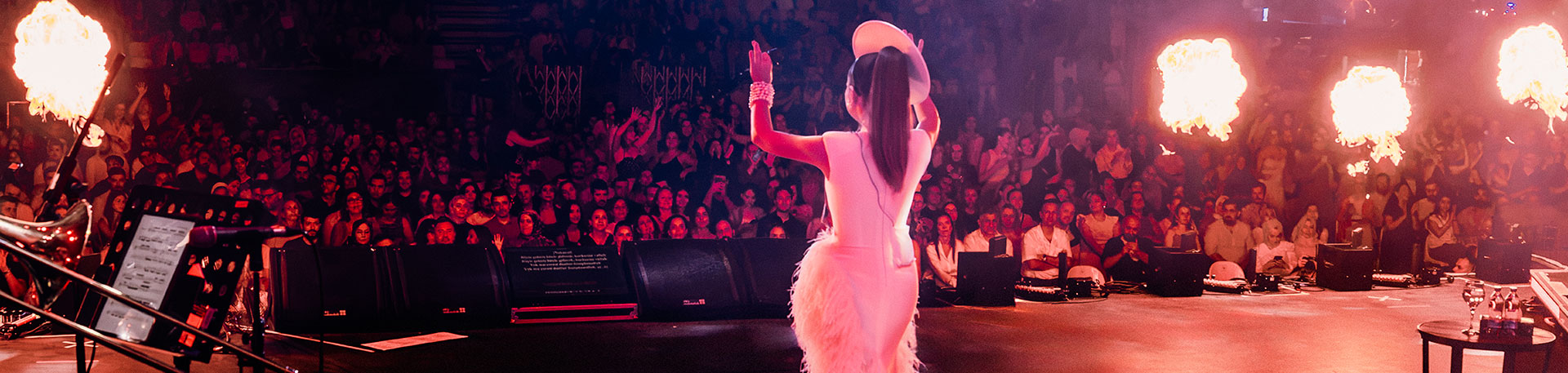
Her duets with Emrah Karaduman, Mustafa Ceceli, Bilal Sonses and Oğuzhan Koç in this period demonstrated an unusual ability to adapt her voice to very different vocal partners. She also maintains a demanding live schedule, performing regularly across Turkey and internationally.
Musical identity
Merve Özbey’s voice sits precisely at the intersection of traditional Turkish classical technique and contemporary pop production. A strong chest register, long-breathed phrasing and an interpretive style that foregrounds the lyric make her particularly effective on dramatic, narrative songs. Her ease of movement between pop, dance, arabesque and soul has allowed her to renew herself across the phases of her career without ever abandoning her core sound.